
Website Link: (Kyrgyz National University) for More Details.
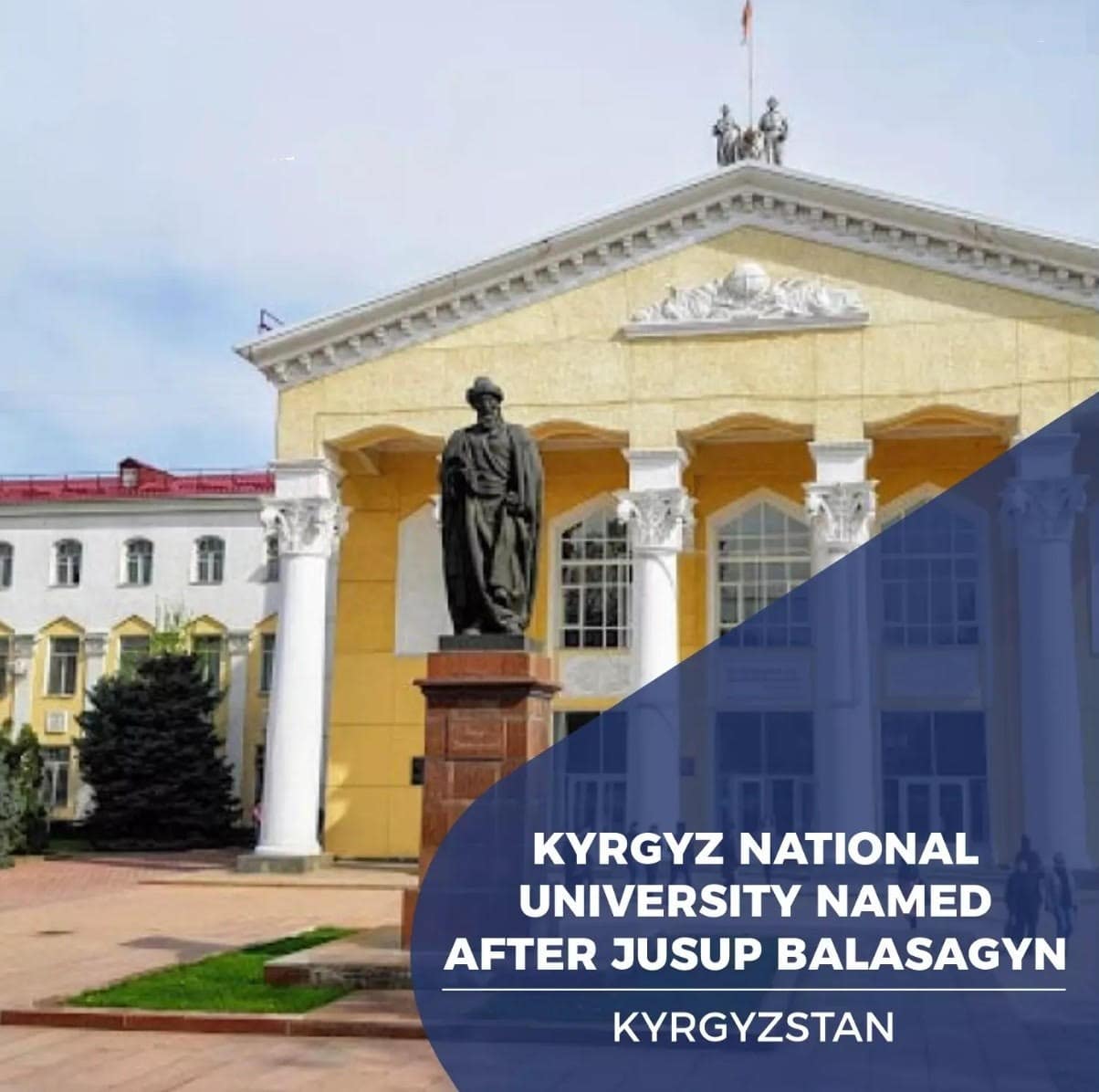
The Kyrgyz National University (KNU) named after Jusup Balasagyn is a public, state-owned higher education institution located in Bishkek, the capital of Kyrgyzstan. Established in 1925, it is the oldest and largest university in the country.
On April 16, 1939, the People's Council of the Kyrgyz Soviet Socialist Republic adopted a resolution, the first paragraph of which read: "Starting September 1, 1939, the Kirghiz State Medical College will open in Frunze with an enrollment of 200 students per year. Professors and instructors from Moscow, St. Petersburg, Kharkov, and Kyiv laid the foundations for the first higher medical schools. In 1943, the first 120 physicians graduated from the Medical University."
(On April 16, 1939, the People's Council of the Kyrgyz Soviet Socialist Republic passed a resolution, the first paragraph of which read: "The Kyrgyz State Medical College will be opened in Frunze from September 1, 1939, with an enrollment of 200 students per course. students". Professors and teachers in Moscow, St. Petersburg, Kharkiv and Kiev laid the foundations for the first higher medical schools. In 1943, the Medical University graduated for the first time with 120 doctors.)
In the 1980s, teaching and research improved significantly. KMU entered the international arena in the field of mountain medical research and promoted the integration of scientific exchanges. Following structural changes, in 1996, by order of the President of the Kyrgyz Republic, the institute was reorganized into the Kyrgyz Medical College. On September 25, 2008, by order of the President of the Kyrgyz Republic, the Kyrgyz Medical University transitioned to a market economy. The college uses contract-based education. Teaching methods and research processes are being modernized. Since 2000, KMU has introduced new courses that meet international standards. Currently, KMU comprises the departments of medicine, pediatrics, dentistry, training of foreign citizens, the faculty of pharmacy, higher nursing education, management and public health, and the faculty of medicine. In addition, the University also houses the KMU Higher School, the Institute of Fundamental Problems of Medicine and Biology, the Center for Advanced Training and Continuing Education, the Biomedical Laboratory, and other institutions. KMU trains doctors for countries near and far. Instruction is provided in Russian and English.
(Teaching and research improved significantly during the 1980s. KMU is on the international stage in mountain medicine research and promotes the integration of scientific exchanges. Following structural changes, in 1996, by order of the President of the Kyrgyz Republic, the institute was reorganized into the Kyrgyz State Medical College. On September 25, 2008, by order of the President of the Kyrgyz Republic, Kyrgyz Medical University introduced contract training. Educational methods and scientific research processes are being modernized.Since 2000, KMU has introduced new courses that meet international standards. Currently, KMU has departments of Medicine, Paediatrics, Dentistry, Departments of Training for Foreign Citizens and Faculties of Pharmacy, Higher Nursing Education, Management and Public Health, and Faculty of Medicine. In addition, there are KMU Graduate Education School, Institute of Basic Issues in Medicine and Biology, Advanced Training and Continuing Education Center, Biomedical Laboratory, etc. KMU trains doctors for neighboring and distant countries. Training is conducted in Russian and English.)